Showing posts with label WORK. Show all posts

Tuesday, July 7, 2015

What to do after job Interview?


Well, you have been along a quit a process (I always say that looking for a job is a job itself): 1. look for positions that would match your background experience and 2. went through the battle of the interview. Now is time for follow-up.


On the internet you can find all kind of templates for follow-up call and emails. I prefer to be more natural writing an email without templates, but based upon the process that I went. I normally call or email 15 days  after the interview. Hopefully you will remember the name of the interviewers.

So meanwhile, you may want to get (if you do not have yet) your SIN number (social number) at the Service of Canada and also  get two pieces of ID. Other important step is to check the contact information of your potential  references. Employers may ask you contact of your previous 3 employers.


Monday, June 22, 2015

Are you going to a job interview? Be prepared!


Nothing can be so nervous than to go to a job interview. But think through, you are having the opportunity to sell yourself!!!

 Since 2010, when I graduated and started to work in Canada, I experienced 4 job hunting (as an immigrant, you are going to get lots of contract term, initially it scares, then you get use to). 

Interviews was another reality for me; in Brazil, I would use my professional skills and discuss technical knowledge to sell myself while in Canada, I have the feeling that you sell more your behavioural skills with a backup of a strong reference letter. Technical skills are mentioned when they ask you to list your experiences. 

In my case, my post-graduation counted negatively, simple because employees thought that I would ask for tons of money ( that is true :0) hahahha), and probably I was too theoretical (that is false).   But in the end of the day, I just want a place where I can work and use my professional skills.

So do not be scared and prepare yourself:
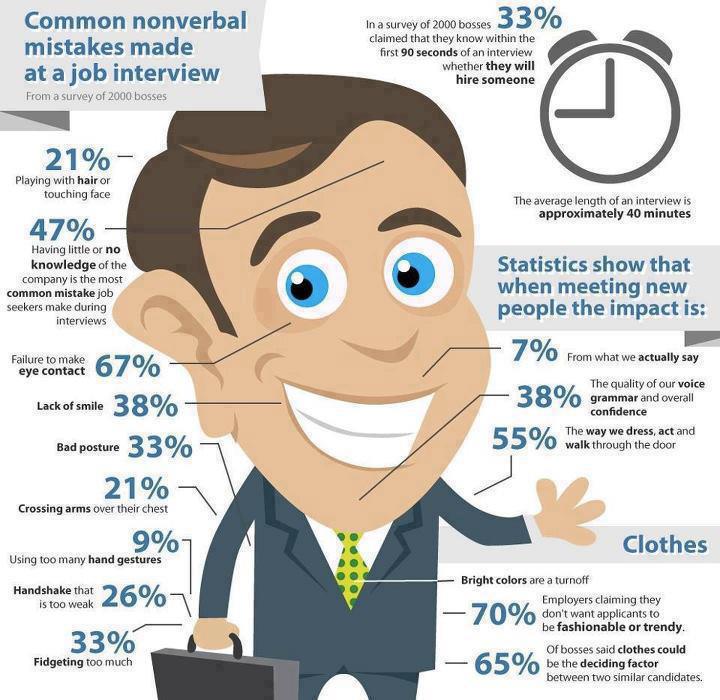
  • Be yourself, dress well, have a strong shake hands, try to smile, make eye contact with all in the room, avoid bad posture, listen and in the end summarize all the points of the interview. I normally forget words in English when I am nervous. So calm down!!!
  • As I mentioned on the post about job hunting , research about the company that you applied, during the interview that may ask why did you apply for this position? or Why this company?
  • Know very well your resume, I normally bring with me a copy of my resume, and slightly look to make sure that the chronological order of my employer are right (it is good to keep a great relationship with your previous manager, because 100% sure, you will need their reference check. Keep the track of their contact information as well).
  • Questions asked will typically be: What would you do if you had a conflict with a co-worker? How did you solved it? What would you do if is 4 pm and you are asked to do an activity that will be demanded to finish? What did you like/hate the most in previous job? How do you see yourself in 5 Years? Why should I hire you? Do you have any question? 


Wednesday, June 17, 2015

Important Things to do before and after you come to Canada


Welcome to Canada: What you should know
Source:www.gic.gc.ca

If you are thinking about coming to Canada, it is best to be as prepared as possible.

Every newcomer's situation is different, so the lists we put here will  provide only an indication of what you may need to do at different stages.
Some of these documents may not be required immediately, but it is better to bring all your official documents with you in case you need them in the future. It is usually more difficult to obtain them after you have left your country.

BEFORE you arrive in Canada:


1. Collect and bring to Canada all official documents belonging to you and the family members who are immigrating with you.
Source: www.qc.cuny.edu
You should prepare:
  • birth certificate
  • passport
  • marriage or divorce certificate, death certificate for a deceased spouse
  • adoption records for adopted children
  • educational diplomas and Certificates. Transcripts that list the courses you took to obtain a degree or certificate. 
  • official vaccination records
  • medical records (test results, x-rays, allergies, prescriptions... ) and dental records
  • driver's licence and/or International Driving Permit 
If the original documents are not in English or Frech, (Canada's official languages) you will need to obtain Certified translations. Here in Atlantic Canada, even if it is a bilingual province, it is most useful to translate the documents into English.
When presenting your documents to Canadian Officials, always provide the original, the certified translation and the name and contact information of the translation agency.

2. Make an effort to improve your English or French. Communicaton skills may be the most important tool you can possess to setle successfully in Canada and find a good job .

3. Plan where you will stay during your first days in Canada. 

4. Prepare yourself to find employment in Canada. Obtain letters of reference from your past  employers, learn how to search and apply for jobs in Canada.
Find out if your occupation is regulated or unregulated. You may need to get your credentials recognized to find work: (http://credentials.gc.ca/recognition/why/licensing-requirements-regulated.asp)

5. Learn about the education system in Canada. Take note of the deadlines for applying and registering at schools, colleges and Universities.

6. Learn more about the province and the city where you will settle. Choose the city where you will live and understand how  much it cost to live there (http://www.cig.ca/english/newcomers/before-cost.asp)

7 .Find out if you need a Temporary Resident Visa to enter Canada. (http://www.cic.gc.ca/english/visit/visas.asp)

8. Make sure you know what you can and cannot bring to Canada. (http//www.cic.gc.ca/english/newcomers/before-goods-what,asp)


AFTER arriving:
Source: http://galleryhip.com
In your first few weeks you will need to:
  • Learn the sources of information to help you meet your needs:You can find contact information for inmigrant-serving organizations across Canada at:  www.cic.gc.ca/english/newcomers/map/services.asp                   
          (We  recommend you :Saint John Multicultural and Newcomers Resource Centre Inc.)
  • Exchange your money for Canadian currency and  open a Canadian Bank Account.
  • Find temporary accommodation
  • Have some identification (ID) with you
  • Apply for a government health insurance card 
  • Apply for a Social Insurance Number (SIN). You can not work in Canada without a SIN . And it is needed to receive goverment benefits.
  • Register your children in school
  • Get a telephone card or a contract with a phone company
  • Get a map of the area and find out about transportation in your area
  • Memorize the national emergency telephone number: 911. If you experience a medical or other type of emergency, do not hesitate to call for help. 

In your first few months:
  • search for a home to rent or buy.
  • get a family doctor or health centre where you can go for your medical needs. 
  • have your children inmunized
  • look for a job
  • try to make friends
  • know where the Language Instruction for Newcomers to Canada (LINC) assessment centre is in your community and register for language classes
  • apply for Canada Child Tax Benefits (call 1-800-387-1193)
  • know if you can apply for the GST/HST Credit ( call 1-800-959-1953 for more information)

In your first year:
  • get a valid driver's licence if you plan to drive in Canada
  • if your first language is not English or French, practice and improve your language skills
  • register for adult continuing education classes
  • participate in community activities
  • understand your rights and responsibilities under Canadian law
  • know that you can apply for Canadian citizenship after living in Canada several years
The Citizenship and Immigration Canada (CIC) website can be found at www.cic.gc.ca and it provides general information about immigration and citizenship programs and services, information about your application, information kits easy to download and help with fee calculations.
You can also call them: 1-888-242-2100 


Friday, June 12, 2015

Canadian Job Hunt....


Now that you choose where to live in Canada, if you are looking for a job, make sure that you know the unwritten hierarchical rule: Canadians - PR - Work Visa - International Students - Temporary Workers

If you are not tied to a specific location, I would suggest you first find an area where there is demand for your profession, then move out.

The strategies above for job hunting are valuable:

1. Targeting -  look for positions that fits your profile and similar areas.
2. Include all - try all sized business, not only multi-national.
3. Networking - meet key people that know "people"
4. Customize resume/cover letter - create a resume for each position  (matching the job description with your experiences)  
5. Use job search tools and social media:
When I was PR, I also counted intensively with the SJMNRC - Saint John Multicultural and Newcomers Resource Centre. They help me with networking, job hunting skills, resume preparation, language training and mock interviews.

Se você ainda está no Brasil, tente aplicar e conseguir uma entrevista. Se você passar por todas as etapas, o empregador, em muitos casos pode lhe ajudar com o pedido do visto do trabalho e com o labour market assessment.

See tips about job interview. 


Monday, June 1, 2015

Escolhendo onde morar no Canadá - West to East Coast

sil´s archive

A população canadense é concentrada a menos de 200km da fronteira com USA, isso é devido à temperaturas extremas ao norte.  Ao escolher uma região para se morar, é bom levar em consideração  fatores como: clima, vida social, possibilidade de emprego e etc.. De uma forma mais ampla,  eu sempre descrevo:


Pacific Canada -  British Columbia - melhor lugar para viver para quem quiser fugir do frio e da neve, porém chove muitooo. Vancouver com uma arquitetura moderna é um lugar caríssimo de morar, mas belíssimo.

Prairies - Alberta / Saskatchewan / Manitoba - Região super fria, chegando aos -40C no inverno, mas com uns dias quentes devido aos ventos Chinook. Booom do oléo e gás, não muito agora com a crise, mas é onde as pessoas fazem $$$$$$$$$.

Central Canada - Ontario / Quebec - Com temperatura um pouco mais amena,  a região é constituída por uma mistura de Metrópoles e sítios históricos. Embora sejam províncias enormes, as capitais e cidades turíticas estão relativamente à 2h de distância umas com as outras (Toronto, Ottawa, Montreal, Quebec City). Por ser mais multicultural e ter mais brasileiros imigrantes nesta região, acho mais fácil achar emprego. 

Maritimes - New Brunswick (onde moro) / Prince Edward Island / Nova Scotia e se incluirmos Newfoundland and Labrador formamos a região Atlantic Canada. Aqui temos menos frio (ohhh -25C) e por causa do Bay of Fundy teoricamente teriamos menos neve, mas nos últimos 2 anos estamo a região está batendo recordes em acumulo de neve, se comparado com os últimos 50 anos. Vida de interior, as pessoas se comprimemtam na rua, vida super calma e segura. Muita natureza para ser contemplada, porén a oferta de emprego não é muito grande. Lado positivo, região mais BARATA de viver.

Northern Canada - Yukon / Northwest Territories / Nunavut - Acho que nem precisa comentar o fato do frio extremo …. aos ambiciosos é a forma de ficar rico a curto prazo, mas pagasse o preço de viver isolado ao resto do país. 


Wednesday, May 27, 2015

Why are we doing this?


Last week, having a cup of coffee at Tim Hortons...  wait a moment,... You haven´t heard about Tim Hortons? That means that you haven´t arrived to Canada yet!. Come with us!
As we were saying, we were talking about our experiences living in Canada, how different some of them were from the ones we had in our countries and how many people were asking us how to immigrate here. So, we decided to start this "canadaeasyguide".
We hope this guide will help you.
We will talk about the themes we are more concerned about or the ones we love, but you can tell us which one you  are interested in and we will try to write about it!